Palworld 1.0 breeding data
Palworld 1.0 Breeding Calculator
Find out which Pal two parents produce, or which pairs can produce the Pal you want. Every answer comes from Palworld 1.0 breeding data and tells you which rule decided it.
Live tool. No reload, no signup.
- 299 Pals
- 273 breed from 2 parents
- 138 special combinations
- 44,851 parent pairs
- rank 20–3,100
Two ways to search
This page is about the calculator itself: what it can do, how it works, the parts it is built from, the rule it uses, the situations players bring to it, the Pals they look up and where the data comes from. After that come base work, the newest articles and the questions readers ask most.
On this page
What Is the Palworld 1.0 Breeding Calculator?
It is a tool that answers two questions: which Pal two parents produce, and which pairs of Pals can produce the one you want.
-
Find the child
Pick both parents and the child appears, with the rule that chose it.
-
Find the parents
Name the Pal you want and you get every pair that can produce it, and you can hide the pairs you cannot breed yet.
-
Plan a chain
Some Pals take more than one breeding step. Start from the Pals you already own and work towards your target.
-
Read the child
See the child's breeding rank, base stats, work suitability, guaranteed passives, partner skill, drops and egg.
How the Palworld 1.0 Breeding Calculator Works
Pick a direction, type the name of a Pal or two, and read the answer underneath. There is nothing to set up first: no account, no options and no game version to choose.
- Step 1 Choose a direction
- Step 2 Type the Pal names
- Step 3 Read the answer
That is the whole procedure, and it is the same in both directions. The calculator looks your pair up in a table built from the game's own breeding data, applies the game's rules to it, and shows you the row it found. Switching direction does not clear what you have already typed.
How to find the child
Choose Find the child, then type one parent in the left box and the other in the right box. A name, a Paldeck number or a nickname all work, and the list narrows as you type. The child appears below with its stats and the rule that chose it. Any two Pals work: the parents do not have to be male and female here, and they can be the same species.
How to find the parents
Choose Find the parents and type the Pal you want. You get every pair that can hatch it, with a Type column saying why each pair works. Search the list, sort it, or tick the Pals you own to see only the pairs you can breed today.
How the breeding formula works
Every pair is checked against three rules in order: a fixed special pair, then two parents of the same species, then the average of the two parents' breeding ranks. The Palworld 1.0 breeding formula guide works through all three with examples you can check against the calculator.
How breeding works in the game
In game the steps are always the same: put a male and a female Pal in the Breeding Farm, keep a Cake in the chest, collect the Pal Egg and hatch it in an Egg Incubator. None of that changes which Pal comes out, because the species is decided before the egg exists, which is the part the calculator tells you in advance. The Palworld Breeding Egg guide covers the egg and the incubation timer.
Palworld 1.0 Breeding Calculator Features
Six things you can ask it: what a pair produces, which pairs produce a Pal you name, whether a pair is one of the fixed combinations, what the child's own details are, which pairs your own Pals can make, and where the data comes from.
-
2
parents in
Parent → Child
Pick both parents and the child shows up straight away, with the rule that picked it.
-
299
targets searchable
Child → Parents
Name the Pal you want and every pair that can make it comes back, ready to search and sort.
-
138
fixed combinations
Breeding combinations
Some pairs are fixed and always hatch the same Pal. Those are checked before any rank is averaged.
-
6
attributes per child
Breeding results
The child's breeding rank, base stats, work suitability, guaranteed passives, partner skill and drops.
-
0
accounts, ads, installs
My Palbox
Tick the Pals you already own and the list shrinks to the pairs you can make today. The list stays in your browser.
-
44,851
parent pairs
Pal breeding data
Every answer says which game version it came from and the date it was last checked.
Components of the Palworld 1.0 Breeding Calculator
Six parts, and they are all on screen at once: a mode switch, the Pal boxes, the result panel, the parent-pair table, three filters and My Palbox.
-
Mode switch
Two tabs: Find the child and Find the parents. Each tab has its own link, so you can bookmark or share the one you want.
-
Pal boxes
Two boxes when you are finding a child, one when you are finding parents. Start typing a name, a Paldeck number or a nickname and the list narrows.
-
Result panel
The child, what chose it, and its own details: breeding rank, stats, work suitability, guaranteed passives, partner skill, drops and egg.
-
Parent-pair table
Every pair that hatches the Pal you searched for. The Type column says why each row works: a fixed pair, two of the same species, or the rank average.
-
Filters
Search by parent name, pick a rarity, or show only the pairs you can make. A long list filters as you type, so you keep typing while the table shrinks.
-
My Palbox
Tick a parent in any row to add it to your list of owned Pals. No account, and nothing is uploaded: the list stays in your browser.
Only six, because the maths is not done here. All 44,851 parent pairs are worked out once, when the data is imported, so the panel just reads the rows it needs instead of running the formula as you type. Those same rows are what the plain pages print, which is how a reader without JavaScript still gets an answer.
Use Cases of the Palworld 1.0 Breeding Calculator
Six things players come here to do: check two Pals they already have, find parents for a Pal they want, re-check a combination from an older build, use only the Pals they own, confirm a fixed pair, and plan a chain of several generations.
Two of the six turn an answer into a plan. Hiding the pairs you cannot make shows you what is actually breedable today, and treating a middle Pal as your next target turns one search into a route several generations long.
| The situation | What you enter | What comes back |
|---|---|---|
| You have two Pals and want the child | Both parents, one in each box | The child, the rule that produced it, and that Pal's attributes. |
| You want a Pal you do not own | The target Pal, in parents mode | Every pair that hatches it, with the Type column naming the rule for each row. |
| You have a combination saved from an older build | The two Pals you remember | What 1.0 hatches now: a remembered pair can have changed since the build it came from. |
| You want to breed from the Pals you have | The Pal you want, with your own Pals ticked in My Palbox | Only the pairs you can make today, usually a small part of the whole list. |
| You are chasing a legendary or a subspecies | The target Pal: a legendary, a raid Pal or a variant | The fixed pair, labelled a special combination, including both outcomes for the one pair that depends on which parent is female. |
| You are planning more than one generation | The middle Pal you still need, as your next target | Its own parent list, so you can walk the route one generation at a time from the Pals you have. |
The calculator does not price the run itself: one Cake per egg, and about ten eggs for a child with the four passive skills you want. The Palworld 1.0 Cakes guide lists the five recipes and what each one changes.
Most-Searched Palworld Breeding Targets
The Pals players search for most, each shown with the number of parent pairs that can produce it.
Parent lists vary a lot in size. Anubis has 234 pairs that can produce it, while the longest list in the data belongs to Felbat, with 1,280 pairs.
Open a Pal to see its breeding page, where the full parent list has its own search, its sort and the Pals-you-own filter.
-
 Anubis
All 234 pairs that can produce Anubis, with the full parent list and the breeding tree.
Anubis
All 234 pairs that can produce Anubis, with the full parent list and the breeding tree.
-
 Blazamut
All 87 pairs that can produce Blazamut, with the full parent list and the breeding tree.
Blazamut
All 87 pairs that can produce Blazamut, with the full parent list and the breeding tree.
-
 Jormuntide
All 210 pairs that can produce Jormuntide, with the full parent list and the breeding tree.
Jormuntide
All 210 pairs that can produce Jormuntide, with the full parent list and the breeding tree.
-
 Katress
All 447 pairs that can produce Katress, with the full parent list and the breeding tree.
Katress
All 447 pairs that can produce Katress, with the full parent list and the breeding tree.
-
 Warsect
All 858 pairs that can produce Warsect, with the full parent list and the breeding tree.
Warsect
All 858 pairs that can produce Warsect, with the full parent list and the breeding tree.
-
 Felbat
All 1,280 pairs that can produce Felbat, with the full parent list and the breeding tree.
Felbat
All 1,280 pairs that can produce Felbat, with the full parent list and the breeding tree.
-
 Astegon
All 104 pairs that can produce Astegon, with the full parent list and the breeding tree.
Astegon
All 104 pairs that can produce Astegon, with the full parent list and the breeding tree.
-
 Frostallion Noct
All 2 pairs that can produce Frostallion Noct, with the full parent list and the breeding tree.
Frostallion Noct
All 2 pairs that can produce Frostallion Noct, with the full parent list and the breeding tree.
The Palworld Paldeck lists every Pal with its base stats, work suitability and partner skill, and each entry links on to that Pal's breeding page.
Palworld 1.0 Breeding Data and Verification
Every answer comes from a dated Palworld 1.0 dataset: the game version, how many Pals and pairs the table holds, and the date it was last checked are all shown with the result.
Every refresh replays all 44,851 parent pairs against the game's own rules, and the table is published only if those replays agree with the game. The current import reports no mismatches.
Where there is no source for a number, the page says so instead of guessing. A Pal that no two different parents can produce still gets a full answer on its own breeding page, naming the route it does have.
| Field | Value |
|---|---|
| Game version | v1.0 (build v28) |
| Pals covered | 299 |
| Breeding combinations | 44,851 |
| Special combinations | 138 |
| Last verified | 2026-09-16 |
| Data source | PalCalc community game-data export (tylercamp/palcalc) + palworld.wiki.gg |
Breeding combinations can change between game versions, so the version and the date it was checked are shown with the result rather than kept on another page.
The data changelog records what each import contained, when it ran, and what is still missing from the table.
Why Choose qvemos.com for Breeding Calculations
Every answer here can be dated and checked: the data is Palworld 1.0, each pair is tested against the game's own rules before it goes live, and the version and check date come with the result.
| What to check | What you get here |
|---|---|
| The order the rules are applied in | Fixed pairs are checked before any rank is averaged, which is the order the game uses. Average first and a special pair can name the wrong Pal. |
| The one pair that depends on gender | Both outcomes for that pair, each one saying which parent has to be female, instead of picking one for you. |
| Pals that no two different parents can produce | A "no pair" answer that names the route the Pal does have, two of its own species, instead of an empty list that looks like a broken search. |
| Numbers the game does not publish | No made-up percentages. A drop rate or a growth rate with no source stays a stated gap, and the dataset behind everything else is named in the section above. |
| What using it costs you | No account, no install and no ads, and your Pals stay in your own browser: the Palbox is the only thing the calculator saves. |
Best Pals by Base Job in Palworld 1.0
The best Pal for each of the twelve base jobs: the one with the highest work level, with work speed breaking a tie. The number after each name is that Pal's work level, taken from the same data every Pal page and every calculator result uses.
-
Best Kindling Pals in Palworld
Renjishi 8 · Jormuntide Ignis 7 · Flaracle 7 -
Best Watering Pals in Palworld
Shaolong 8 · Jormuntide 7 · Neptilius 7 -
Best Planting Pals in Palworld
Dandilord 8 · Ophydia 7 · Lyleen 7 -
Best Generating Electricity Pals in Palworld
Orserk 8 · Solmora Lux 6 · Dynamoff 6 -
Best Handiwork Pals in Palworld
Solenne 8 · Selyne 7 · Anubis 6 -
Best Gathering Pals in Palworld
Jetragon 8 · Starryon Primo 7 · Hartalis 7 -
Best Lumbering Pals in Palworld
Celesdir Noct 8 · Celesdir 7 · Hartalis 7 -
Best Mining Pals in Palworld
Aegidron 8 · Blazamut 7 · Blazamut Ryu 7 -
Best Medicine Production Pals in Palworld
Silvance 8 · Lyleen Noct 7 · Bellanoir Libero 7 -
Best Cooling Pals in Palworld
Bastigor 8 · Frostallion 7 · Univolt Cryst 6 -
Best Transporting Pals in Palworld
Knocklem 7 · Knocklem Ignis 7 · Wumpo Botan 6 -
Best Farming Pals in Palworld
Dumud Gild 4 · Sibelyx Primo 4 · Beegarde 3
Latest Palworld breeding articles
Breeding notes, patch changes and the numbers behind them, written from the same data the calculator uses. The full list of guides has its own page.
-
Palworld Breeding Farm: How It Works, How to Unlock It, Where to Build It, and Everything about Breeding Farm
The Palworld Breeding Farm is the structure used to breed two Pals and produce Pal Eggs. In the current Palworld 1.0.3 data, the farm… -

Palworld Pal Generation Tracking: What It Is, Why Track It, How It Works and Everything about Generation Tracking
Learn Palworld Pal Generation Tracking, including how to record parents, offspring, generations, breeding chains, Passive Skills, variants, mutations, and breeding routes. Palworld Pal Generation… -
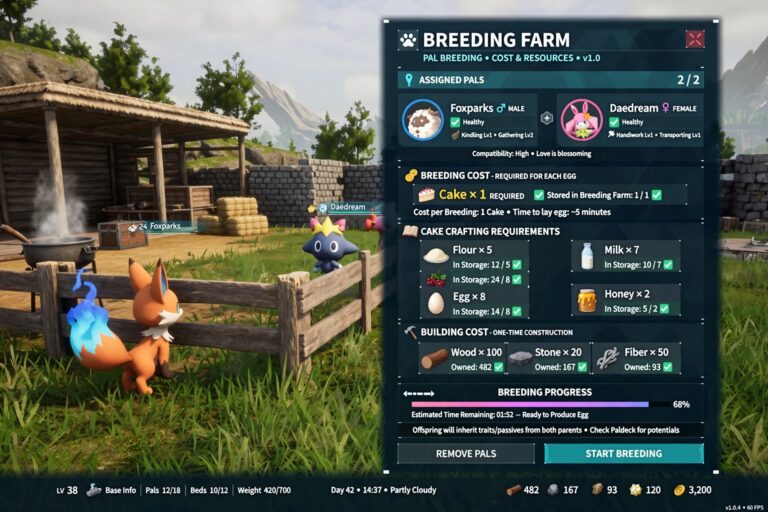
Palworld Pal Breeding Cost: What It is, How to Calculate it, How to Reduce it and Everything about Pal Breeding Cost
Learn Palworld Pal Breeding Cost, including Breeding Farm materials, Cake recipes, breeding attempts, egg costs, mutation costs, Passive Skills, and breeding chains. Palworld Pal… -

Palworld Breeding Egg: What it is, How to get it, Time Taken to Hatch, Egg Size and all about Breeding Eggs
Learn how Palworld Breeding Eggs work, how to get breeding eggs, hatch them, predict offspring, use Passive Skills, and understand mutation breeding. A Palworld… -

Palworld Pal Mutation: What it is, How it Works, Chances of Mutation, Mutation Passive Skills and Everything about Palworld 1.0 Pal Mutation
Learn how Palworld Pal Mutation works, how mutated eggs are created, mutation chances, exclusive Passive Skills, Alpha Pals, and mutation breeding strategies. Palworld Pal… -

Palworld Pal Passive Skills: What it is, How it Works, It’s Types, Importance and Everything about Palworld Pal Passive Skills
Learn how Palworld Pal Passive Skills work, how to choose skills for combat and work, and how Passive Skills fit into Pal breeding and… -

Palworld 1.0 Breeding Combination: What is it? How it Works? How to Find the Right Breeding Combination? and Everything about Breeding Combination
Learn how Palworld 1.0 breeding combinations work, how to find parent pairs, build breeding chains, use intermediate Pals, and plan Passive Skills. Palworld 1.0… -
Palworld Breeding Offspring Prediction: How to Predict Breeding Results
Palworld breeding offspring prediction helps players determine which Pal can hatch from two breeding parents before producing an Egg. By understanding how the breeding… -
Palworld 1.0 Breeding Parents: What it is, How it Works, How to Choose Pal Parents, and Everything about Pal Parents
Palworld 1.0 breeding parents are the two Pals selected at the Breeding Farm to produce a Pal Egg. Choosing the right parents is important…
Palworld Breeding Calculator FAQ
Short answers about the calculator, what it can do, how a result is worked out and who runs the site. Four tabs, so open the one you need.
Calculator
What does the Palworld breeding calculator do?
It reads the game's own breeding table to answer two questions: what two parent Pals produce, and which parent pairs can produce a Pal you name. The child, its breeding rank, base stats, guaranteed passives, partner skill and drops all arrive with the result.
How do I find what two Pals produce?
Open Parents → Child mode, pick Parent A and Parent B, and the child appears in place with no reload. Each box matches a Pal by name, Paldeck number or a known alias.
How do I find the parents for a specific Pal?
Open Target → Parents mode and name the Pal you want. The calculator returns every pair in the 1.0 table that hatches it, and the list keeps its search, its sort and the Pals-you-own filter however long it runs.
Is the calculator updated for Palworld 1.0?
Yes. The running dataset is Palworld v1.0 (build v28), last verified 2026-09-16, and both are printed with the data table on this page so a patch can be checked against them instead of trusted.
Can I search by Pal name or by Paldeck number?
Both work, in either direction. Type a name, a Paldeck number, or the alias a Pal is better known by, and the list narrows as you type.
Does parent order matter when I enter the two Pals?
No. Either Pal can be entered first, and the average lands in the same place whichever way round the pair is written. One pair is the exception: it hatches two different children depending on which parent is the female, and the calculator shows both outcomes instead of choosing one for you. The Palworld 1.0 Breeding Combination guide lists it with the rest of the fixed combinations.
Does the calculator include the special breeding combinations?
Yes. The 138 fixed combinations are checked before any rank is averaged, and a result that comes from one is labelled a special combination so the two routes are never confused. They cover 90 different children. The Palworld 1.0 breeding formula guide sets out the rule order.
Do two of the same Pal breed, and can the legendaries be bred?
Two of the same species always breed true, which makes a pair of one species the cheapest way to reroll passive skills. It is also the only pairing that works for 26 Pals — the legendaries, the raid bosses and a few subspecies — because no two different parents can reach them.
Why does a target Pal show only one parent pair?
Because it sits outside the pool the child is drawn from, so no two different parents can land on it. 26 of the 299 Pals are in that position, and the single row listed is the Pal with itself. That row is the whole route rather than a list cut short.
Features
What does the calculator show alongside the child?
Every result carries the child's breeding rank, base stats, work suitability, guaranteed passive skills, partner skill, drops and egg, and links to that Pal's own page, where the same attributes sit beside its complete parent list.
How long can a parent list get, and is it cut off?
Nothing is truncated. Felbat has the longest list in the 1.0 table at 1,280 pairs, and all 1,280 are on the page. The list is sorted, filtered and loaded a screenful at a time in the browser rather than summarised.
Can I filter or sort a long parent list?
Yes. Every pair list carries a search box, a sort, and the Pals-you-own filter, so a list running to four figures can be narrowed to the handful of pairs you can breed today without leaving the page.
What is My Palbox, and does it upload my Pals?
My Palbox is the list of Pals you own, kept in your own browser and used to filter every parent list to the pairs you can actually breed. There is no account to create and nothing is uploaded: the list never leaves the device, and the Palbox page clears it.
Can the calculator plan a multi-generation breeding chain?
It shows the route rather than planning the whole project: every breeding page draws the direct path as a tree with both parents above the child, and each parent links to its own page, so a chain is walked one generation at a time. The Palworld Pal Generation Tracking guide covers recording each stage as you go.
Does the calculator predict passive skills, stats or mutations?
Not as a prediction, and it does not claim to. The species is deterministic; passive skills, stat growth and a mutation are all rolled after the hatch is decided. The Palworld Pal Passive Skills guide gives the inheritance odds and the Palworld Pal Mutation guide covers the 1% mutation roll and the Cake that raises it.
Do I need an account or an install, and is it free?
No account, no install and no ads. The calculator runs in the page, so a search is one pick away, which is the whole reason Pal Breeding Calculator keeps no login, no save button and nothing to dismiss first.
Can I bookmark or share a result?
Yes. The mode and the pair are written into the page address as you use the calculator, so the URL in the address bar is the result: copy it and the same pair opens in the same mode for whoever you send it to.
Technology
Where does the breeding data come from?
The source is PalCalc community game-data export (tylercamp/palcalc) + palworld.wiki.gg: a structured export of the shipped game data merged with the community wiki for the parts the export does not carry, such as partner skills and drop tables. That is 299 Pals and 44,851 precomputed parent pairs. The data changelog records what each import contained and when it ran.
How is a result verified before it is published?
Every refresh replays all 44,851 parent pairs against the game's own breeding table and compares the outcome with a reference implementation of the same algorithm. Nothing is published until those replays agree; the current import reports zero mismatches.
How is the child actually worked out?
Three rules, applied in order: a fixed special combination, then two parents of the same species, then the average of the two hidden breeding ranks, floor((rank A + rank B + 1) / 2), with ties going to the lower index. The breeding formula guide sets the three rules out in order with worked examples.
Does the site recalculate every pair on each visit?
No. The 44,851 pair rows are built once at import time and stored on the 299 Pals they belong to, so a page renders from stored data instead of running the formula per request. That is what keeps a page listing a thousand pairs as fast as one listing three.
Why might another calculator give a different child?
Usually one of three things: a table older than 1.0, a calculator that averages ranks without checking the 138 fixed combinations first, or one that ignores the single gender-sensitive pair. The dataset here is Palworld v1.0 (build v28), last verified 2026-09-16, and both are printed on the page so a disagreement can be dated rather than argued about.
What is still missing from the data?
Three things, each labelled rather than filled in: no source publishes a per-Pal World Tree drop table, no element typings exist in the current export so element filters stay hidden, and 26 Pals hatch only from two of their own species. No percentage is printed where the game publishes none. The mutation and inheritance odds that do exist are the game's own rules, and the Palworld Pal Breeding Cost guide prices the resources a project needs.
Does the site use cookies or track visitors?
The only state the calculator keeps is your Palbox, and it stays in your browser. What the site itself stores, and what it does not do with it, is set out in the privacy policy and the cookie policy rather than summarised here.
About us
Who runs Pal Breeding Calculator?
Pal Breeding Calculator is an independent, fan-made reference for Palworld 1.0 breeding, built and maintained by players who breed. It exists because the 1.0 update moved breeding combinations and the older published charts stopped matching the game. Corrections and questions go through the contact form.
Is this an official Palworld site?
No. Pal Breeding Calculator is unofficial and is not affiliated with, endorsed by or sponsored by Pocketpair, Inc. Palworld, the Pal names and designs, item names and the underlying game data belong to Pocketpair and their respective owners; they appear here to identify what each page is about, with no claim of ownership. The disclaimer states it in full.
How do I report a wrong result or a typo?
Send it through the contact form with the page and the pair you were checking, and it is fixed in the next data pass rather than in a comment nobody reads. What was imported in each pass, and what was changed, is listed in the data changelog.
How often is the site updated?
Whenever the game data moves: the table is re-imported, all 44,851 parent pairs are replayed against the rule set, and the version stamp updates with it. The site is currently on Palworld v1.0 (build v28), verified 2026-09-16, and that stamp is printed with the result on every page rather than kept on an about page alone.
Can I reuse these pages or the data?
Short quotes with a credit and a link are welcome. What the site wrote is the site's; Palworld and its assets are Pocketpair's; and a rights holder can ask for something to be taken down, which is what the copyright page sets out.
Which languages does the site cover?
English, with Spanish in progress at qvemos.com/es. The translated pages carry the same data and the same answers; they are kept out of the index until the wording is finished, so a half-translated page is never served as the Spanish version of an English one. Every result on Pal Breeding Calculator is stated in English, whatever language the page around it uses.
What does the site do when a number cannot be verified?
It says so. Nothing on this site is estimated to fill a gap: a Pal with no cross-parent route says that, a drop table no source publishes stays empty, and a stat with no published rate prints no percentage. A stated gap is more useful than a plausible number that cannot be checked.
Start With the Palworld Breeding Calculator
Type two parents to see their child, or type the Pal you want to see every pair that can hatch it. Both open the same calculator, and each answer says which rule decided it.